The painter of Lebanon’s mountains
Lebanese painter Tamara Haddad focuses on war, ecological devastation, and the physical transformations taking place on earth through her work, which places nature at its center. In her exhibition “À Mon Père,” which ...
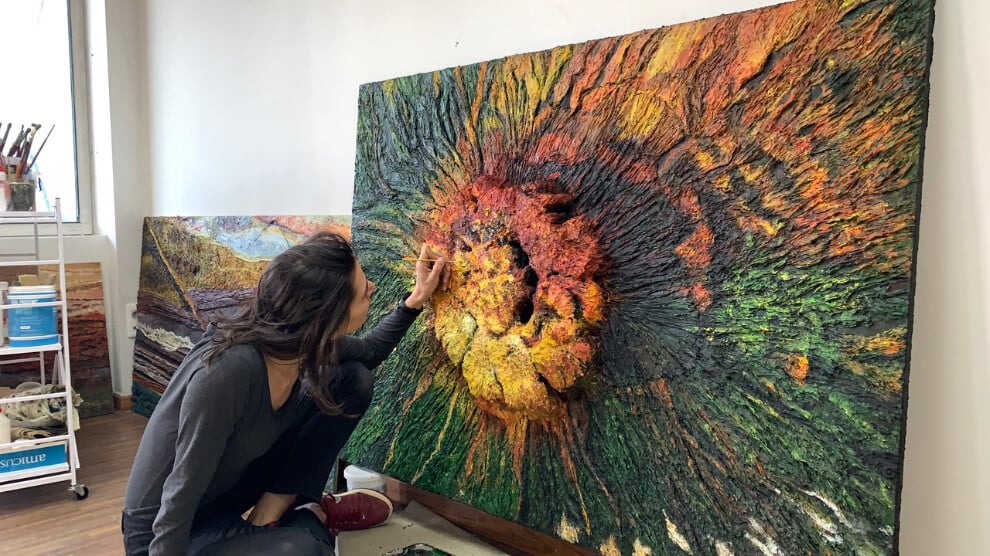
Lebanese painter Tamara Haddad focuses on war, ecological devastation, and the physical transformations taking place on earth through her work, which places nature at its center. In her exhibition “À Mon Père,” which opened at Galerie Tanit in April 2026 and which she dedicated to her father, the artist treats trees as living beings. Using sand, tree bark, stone, and fragments of branches, Haddad transfers onto her canvas her observations stretching from the mountains of Lebanon to the Port of Beirut.
We spoke with Haddad about her work, about Beirut in the shadow of war, about the survival instinct of the Lebanese people, and about the role of the artist in society.
What inspired you to focus exclusively on environmental and natural scenes in your artistic work? Why is this subject so important to you personally?
15 years ago, when I was working in an advertising agency a mile away from home, I walked twice every day, breathing polluted air and gas coming from cars. I was very conscious of it and was horrified by the idea that I would have to breathe this every day for years. I was also obsessed by the garbage crisis in Lebanon, where it is stacked in mountains everywhere in the country with no recycling plan. I was also very conscious of the fact that Beirut is one of the most polluted cities in the world, due to the negligence of the government regarding environmental matters such as garbage management, and the absence of construction regulations resulting in landscape destruction to build tall buildings, especially in the Lebanese mountains. I was and still concerned by these matters, being raised in a house where art is very present, with my father being an architect very respectful of nature.
Your current solo exhibition is entitled “Roots of Memory and Matter.” What kind of paintings can visitors expect to see there, and what physical materials from nature do you use to create these works?
My current exhibition at Galerie Tanit Beirut is entitled “To my father,” dedicated to him, who left this world in January, while I was working on this series. This series talks about trees. My father used to love trees, to plant them and to carry about them. Trees are also one of many environmental topics I am working on. I started this series in 2024, painting deforestation and wildfires that are happening nowadays on this planet. Then I read an aphorism written by Khalil Gibran that talks about trees as poems, and I decided to paint trees in their beauty, trying to make people more sensitive about nature and its beauty. As I do a lot of hiking trips in Lebanon and abroad, I get inspired by my own photographs taken during these trips. My paintings are made with a thick texture, layers of sand, acrylic and oil paint, adding some natural elements such as branches, leaves, tree bark. Natural materials is essential in my process, reflecting the variety of natural textures.
The exhibition description states: “Trees stand, grow, and remain. They hold memory in a way that feels grounded.” Could you explain this idea to us in more detail, and the deeper significance of roots and trees in your work?
Trees are like humans. They grow, they breathe, they have roots, but most importantly, they are essential to human life. They are the Earth’s lungs, our lungs. They are an element of nature that we don’t see anymore. We don’t pay attention to trees, we are focused on our everyday life, far from nature, ignoring the importance and the impact of nature on our lives. I think today, we are facing environmental challenges that are having a direct impact on our lives and our health, but we are in a sort of denial. Through this exhibition I am trying to awaken people to the importance of nature, to let them contemplate trees, light, colors and to slow down time.
Should artists today play a stronger social role in opposing capitalist consumption, environmental crises and violence?
Many artists around the world are working on environmental issues, especially photographers such as Edward Burtynsky or Yann Arthus Bertrand, and other artists such as Julian Charrière, creating art installations focusing on climate change and consumption. They are doing great jobs. Artists are creating shows that touch people but are unable to make significant social changes as they are confronted by political restrictions. And politics is related to economic matters, and often to personal benefits, especially in Lebanon. Unfortunately, emerging countries such as Lebanon and other countries in the Middle East and Africa are busy struggling with economic issues, poverty and corruption, making environmental issues a less important matter.
In an interview, you say: 'Lebanon has always lived that way. It gets up after years of crisis, only to sink again.' What are life and everyday existence like in Lebanon in the shadow of crisis, violence and war?
Since I was born, in 1982, Lebanon has been at war. Every ten years, there is a crisis. We are used to living this way; we never lived otherwise. We are adapted to crises, we know how to face them and to manage our lives with them. There is a positive thing about it, which is that we live every day as our last day. We don’t postpone anything; we don’t have plans for the future because the future is just tomorrow. We have learned to enjoy every moment and to be grateful for what we have today.
Southern Lebanon is under Israeli occupation. Hundreds of thousands of people are being uprooted and displaced. When politics fails: how does Lebanese society, across the political divide, respond to this existential crisis, and how do you experience the mutual solidarity among people in the struggle for sheer survival?
The people of South Lebanon are Lebanese first. And this is not the first time they have moved from their lands. And it is not the first time they have been hosted and helped by other Lebanese in other regions. Lebanon has always been a country of different communities living together and helping each other. And we have already faced civil war. We know that Lebanon cannot face it again today. Nobody wants this. So, there is an awareness to avoid a new civil war. Plus, solidarity is one of Lebanese people's qualities. We are helpful by nature, despite all what we have been through.
What is everyday life like for young artists in Lebanon? What do they get up to, how do they interact, and where do they go?
For an artist, life in Lebanon is not easy, as artists don’t have any support. But they have inspiration. Lebanon, especially Beirut, has always been a hub of culture and art. Beirut holds a significant number of art galleries and institutions due to the plurality and to the different cultures living together.
Lebanon gives a lot of topics for artists, spanning from social and political crisis to beautiful and variant nature. Lebanon is a vibrant country where a lot of things happen, which creates a lot of matters for artists to work on. War and violence are very present in artists' language, even if artists have a hard life. Suffering is often a great source of creation. Though it is not always easy to create in a tense environment, many artists struggle to work, but I think they find a balance between hard times and creation. From my side, I often escape into nature to be able to breathe, to resource and to gain strength.
Lebanese music is among the most fascinating and well-known in the Middle East. Can it still be a source of joie de vivre [joy of life] amidst the country’s current crisis? Are concerts still being organised and new music produced, or is there simply no scope for that?
Lebanese music was the most successful and beautiful during the golden age of Lebanon, in the 60s and 70s. Nowadays, there are many music artists and many styles, especially with the AI… and no doubt, music plays a big role in Lebanese life and joie de vivre, it has always been a big part of our culture. Since 2024, having two wars, Lebanon has been struggling to organize concerts, but though some festivals, such as the Baalbek international festival, managed to organize a few beautiful concerts. They are also planning some concerts for this summer.
How do people in Beirut manage to retain their zest for life despite the constant threat, and what role do artistic creation and the pursuit of creative beauty play as a form of resistance?
Beirut is a vibrant city and will always be. Beirut people are festive and like to enjoy every moment. Going out and having fun is essential to keep going and to face crisis. Art is, of course, a form of resistance as it is a kind of soft power. Artists are able and are free to express themselves through their art and are always aware to preserve Lebanese culture.
Who is Tamara Haddad?
Born in Beirut in 1982 into a family intertwined with art and architecture, Tamara Haddad was greatly influenced by her father, Georges Haddad, one of the pioneers of Lebanese modern architecture. In 2005, she completed a master’s degree in advertising at the Lebanese Academy of Fine Arts (ALBA). While working in this field, she began painting as a self-taught artist. Devoting herself entirely to painting from 2011 onward, the artist inscribes into her works the extraordinary travels that extend from Beirut -where she still lives today- to all corners of the world, along with the impressions she has gathered from these journeys. To date, Haddad has held exhibitions in many different.